
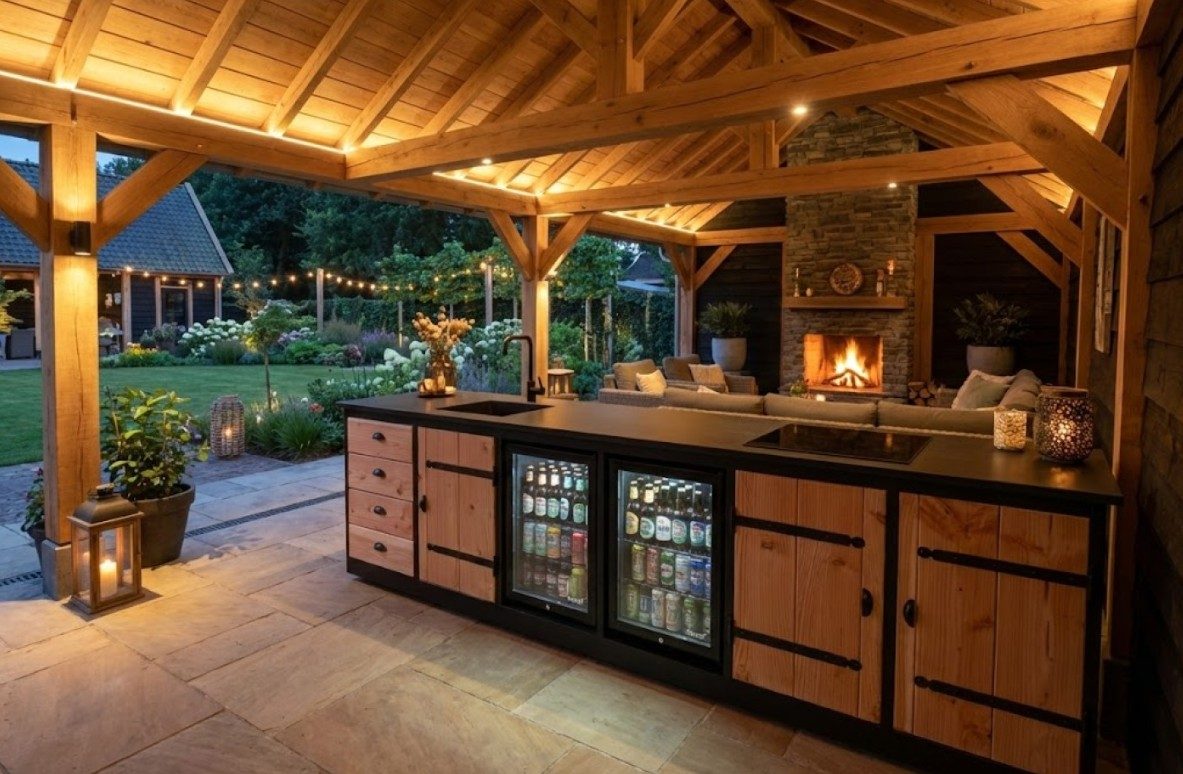
A wooden outdoor kitchen needs maintenance, but that doesn't have to involve aggressive cleaning products or synthetic coatings. If you treat your materials with care, natural alternatives will get you a long way. In this blog you'll read how.
Why no chemicals?
Chemical cleaning products do their job, but they also damage the wood. They slowly break down the cell structure of Douglas fir, remove the natural oils and make the wood more vulnerable to moisture and UV rays. What's more, residues are washed by the rain straight into the garden, the very environment you're trying to enhance with biophilic design. Natural alternatives work more gently, nourish the material instead of stripping it, and are safe for the plants, insects and soil around your kitchen.
Regular maintenance: cleaning wood
- For daily and weekly use, warm water with green soap is the most effective and safest solution. Green soap is biodegradable, degreases well and is mild enough to leave the wood structure intact. Use a soft brush or cloth; scouring pads scratch the wood and open up the pores to moisture.
- Always rinse with clean water and let the wood dry before you cover it. Moisture trapped under a cover is a bigger enemy of wood than rain itself.
- For more stubborn stains, such as burnt-on grease or red wine residue, a paste of baking soda and water works well. Apply it to the stain, let it soak in briefly and rub it away along the grain of the wood. Not across it: that pulls the fibres open.
Protecting wood: oils and coatings
Douglas fir naturally has good resistance to moisture and fungi, but outdoors it needs structural protection. The best choice is a natural wood oil or teak oil based on plant-based raw materials, such as linseed oil, tung oil or a blend of both.
These oils penetrate deep into the wood, nourish it from within and don't form a closed film that can flake later. Apply the oil to clean, dry wood, preferably at the start of the garden season and again at the end. Two thin coats work better than one thick one. Once it has soaked in, wipe off any excess oil with a dry cloth, otherwise the surface will become sticky.
Avoid products based on varnish or polyurethane. They seal the wood hermetically, so any moisture that does get in through gaps or end grain can no longer escape. That's exactly how rot starts.
Maintaining the worktop
Depending on the material of your worktop, it needs a different approach.
A stone worktop stands up well to water and heat, but grease and acids (lemon juice, vinegar) can damage the surface over time. Clean it with warm water and green soap and then dry it well. Avoid vinegar as a cleaning product on stone; although it degreases, it damages the surface structure with repeated use.
A wooden chopping surface or worktop is best treated regularly with food-grade mineral oil or a beeswax product. That keeps the wood supple, prevents cracks and is completely safe in contact with food.
Mould and green algae
In a damp autumn or winter, green algae can form on the wood. The most effective natural approach is a solution of water and white vinegar (ratio 1:1), applied with a brush. Leave it to work for a quarter of an hour and rinse off with water. Vinegar is a weak acid and effectively kills mould spores without structurally damaging the wood, provided it isn't used routinely as an everyday cleaning product.
For more severe green algae, a diluted solution of hydrogen peroxide (3%) also works well. It oxidises the growth without leaving toxic residues behind.
Prevention is more effective than cure, however: make sure there's enough air circulation around the kitchen, avoid prolonged contact with wet leaves and cover the kitchen in winter with a breathable cover, not plastic, because that traps moisture.
Natural products at a glance
| Problem | Natural product |
|---|---|
| Grease and dirt on wood | Warm water + green soap |
| Stubborn stains on wood | Paste of baking soda and water |
| Green algae and mould | Water + white vinegar (1:1) |
| Severe green algae | Hydrogen peroxide 3% |
| Limescale on metal | Lemon juice or diluted citric acid |
| Protecting wood | Linseed oil, tung oil or teak oil |
| Wooden chopping surface | Food-grade mineral oil or beeswax |
Metal parts
Handles, hinges and taps are often made of stainless steel or galvanised metal. These are best cleaned with warm water and a drop of washing-up liquid. For limescale, visible as a white deposit around the tap, lemon juice or diluted citric acid works brilliantly. Apply it, leave it for five minutes and wipe it away. No aggressive abrasives: they scratch the metal surface and actually make it more prone to rust.
Maintenance by season
Most of the work comes at the change of the seasons. At the start of the garden season, clean the kitchen thoroughly with green soap, treat any green algae and oil the wooden parts again. During the season, wiping with a damp cloth after use is enough; then dry metal parts to prevent limescale.
At the end of the season, clean everything, let it dry completely and cover the kitchen with a breathable cover. After a wet spell, it's worth checking the wood for green algae and treating it with a vinegar solution if necessary.