
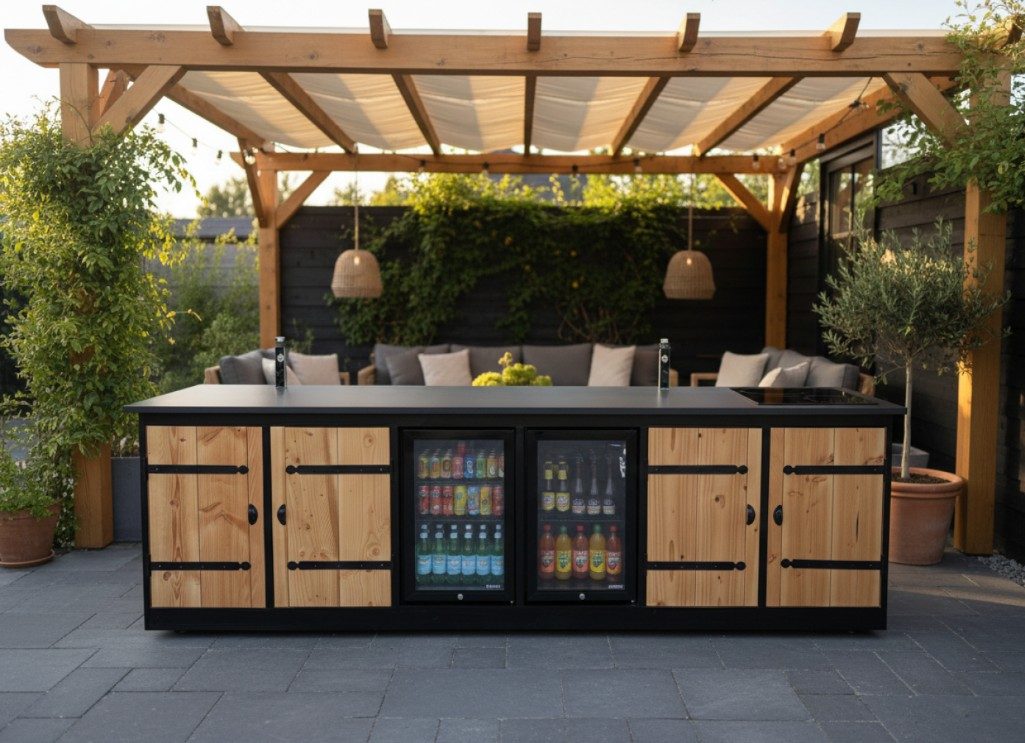
It's not the weather that affects a wooden outdoor kitchen the most – it's the small maintenance mistakes that pile up year after year. This blog lists the five most common mistakes, so that you can avoid them.
1. Covering wood with plastic without letting it dry
The most common mistake, and also the most damaging. A plastic cover seems logical – it keeps the rain out. But if the wood is even slightly damp when you cover it, you trap that moisture inside. Plastic doesn't breathe, so the space under the cover becomes a breeding ground for mould and rot.
Always let the outdoor kitchen dry completely after a rain shower or clean before you cover it. And use a breathable cover made of polyester or canvas, which lets moisture escape but keeps rain out.
2. Treating wood with varnish or polyurethane
It seems like good protection: a hard, glossy layer that repels water. In practice it has the opposite effect. Varnish and polyurethane have a number of major drawbacks on outdoor wood:
- Moisture still gets in through the end grain, small gaps or damage in the varnish – and can't get out again. That's exactly how rot develops from the inside.
- After one or two seasons the varnish starts to flake, so you have to keep sanding it down and reapplying it.
- Every maintenance session wears the wood down further instead of protecting it.
The right choice is a penetrating oil based on plant-based ingredients, such as linseed oil or tung oil. It soaks deep into the wood structure, nourishes the wood from within and lets it breathe.
3. Cleaning with harsh cleaning products
Bleach, ammonia-based degreaser, chlorine – they work quickly and seem effective. But they break down the cell structure of Douglas fir, strip out the natural oils and make the wood more porous, and therefore more vulnerable to moisture and UV radiation. Over time you'll see this as greying, hairline cracks and a rough, dull surface.
Warm water with green soap is always enough for regular maintenance. For stubborn stains, a paste of bicarbonate of soda and water works well. For green algae or mould, use a solution of equal parts water and white vinegar – effective without damaging the wood.
| Problem | Don't use | Do use |
|---|---|---|
| Grease and dirt | Ammonia-based degreaser | Warm water with green soap |
| Stubborn stains | Bleach or chlorine | Paste of bicarbonate of soda and water |
| Green algae and mould | Chlorine-based cleaning products | Equal parts water and white vinegar |
4. Not treating the end grain
The end grain of wood – the sawn edges at the end of a board – is the weakest point of any wooden outdoor furniture. Wood absorbs up to ten times more moisture through the end grain than through the sides. Yet it's the part most often skipped when oiling an outdoor kitchen, simply because it's less visible.
At every maintenance session, make a point of treating the end grain with extra oil. Let the oil soak in longer there than on the rest of the wood, and preferably apply two coats. This also applies to places where the kitchen rests on wheels or comes into contact with the floor.
5. Only doing maintenance in summer
If you only give your outdoor kitchen attention during the garden season, you miss the two most important moments: the start and the end of the season. It's precisely the transition from winter to spring, after months of cold, damp and temperature changes, when damage becomes visible and needs treating before the season begins.
And the end of the season is just as critical. Wood that goes into winter dirty, damp or untreated has months to go mouldy or discolour. A thorough clean, a coat of oil and a properly breathable cover before the first frost prevent more damage than all the summer maintenance sessions put together.
How do you recognise premature ageing?
Greying of the wood is usually the first sign: it points to UV radiation combined with too little oil. Sanding and re-oiling is then the right approach. Green algae indicates moisture and poor air circulation around the kitchen, which can be treated with a vinegar solution and, where possible, better ventilation. A flaking finish gives away the use of varnish or polyurethane: sand it off and switch to a penetrating oil.
Hairline cracks in the wood are caused by drying out, often due to harsh cleaning products or too little maintenance. Paying extra attention to the end grain when oiling solves this. Finally, soft or spongy wood is the most serious sign: it points to rot caused by trapped moisture. Remove the affected parts, treat the rest and make sure it's properly covered.